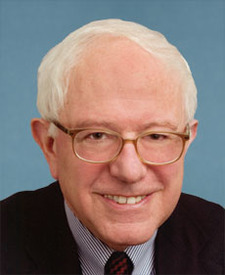
Bernard Sanders
Bernie Sanders does not hold or trade individual stocks; his household assets are reported in mutual funds, federal credit union accounts, and annuities, and no STOCK Act periodic transaction reports of individual securities trades are on record. His estimated net worth (roughly $2-3 million) is largely attributable to his Senate salary and substantial book royalties ($148,750 in 2024 alone), which are disclosed lawful income rather than market enrichment tied to his office. OpenSecrets data shows industries such as pharmaceuticals appearing high among his contributors, but reporting confirms this reflects small-dollar donations from rank-and-file employees rather than corporate PACs or executives, which Sanders does not accept. His most cited campaign-spending issue is over $550,000 in 2025 campaign funds for private jet travel (including ~$354,000 to Ventura Jets), which FEC filings categorize as campaign travel for his rallies rather than personal use. Family entanglement concerns center on his wife Jane Sanders advising his campaigns and the now-closed Sanders Institute, which paid his stepson roughly $100,000 annually; the institute suspended operations to avoid the appearance of impropriety. He has missed about 12.7% of lifetime roll-call votes, well above the Senate median, driven largely by his 2016 and 2020 presidential campaigns.
Public record
- In Congress since
- 1991
- Committees
- Health, Education, Labor, and Pensions (Ranking Member)
Environment and Public Works
Finance
Budget
Veterans' Affairs - Missed votes, 119th Congress
- 7.0% (64 of 915; median member 1.9%)
- Campaign money, 2025–26 cycle
- $25M raised · 0% from PACs & committees · $23M cash on hand FEC ↗
The stock-trading ban
H.R. 7008 bans new stock purchases by members, spouses and dependents; it doesn't force sales of existing holdings. The Senate vote was on the version paired with the SAVE Act, which is why no Democrat voted yes. Full breakdown →
Disclosed stock trades
No periodic transaction reports on file since 2024. That's the norm: most members don't trade individual stocks, or hold them in blind trusts and diversified funds.
Amounts are the ranges members must report, not exact values. The STOCK Act requires a report within 45 days of a trade; "late" counts days past that deadline, measured to the filing date.
How the score breaks down
Sources behind this score: 2 data aggregator · 1 official record · 6 news reporting · 4 reference database. Score = weighted average of the components that have data; the 0 without sourced evidence are excluded, never counted against the member. Methodology →
Embed this score on your site

Updates automatically when the score changes.
Right of reply
Is something here wrong or missing context? Members and their staff can send a correction or a statement. Statements are published on this page in full, and corrections go in the public log. Email corrections@greederboard.com.