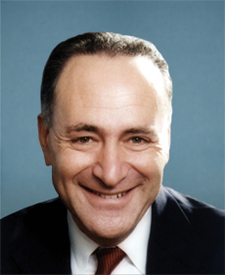
Charles E. Schumer
Chuck Schumer, the Senate Democratic leader from New York, presents a comparatively low self-dealing profile on personal financial measures but elevated exposure on influence-adjacent measures. Public trackers (Quiver Quantitative, Capitol Markets) record no individual stock trades for Schumer, consistent with his on-record statement that he owns no individual stocks, which scores stock_trading at zero. His disclosed net worth is modest for a senator, estimated in the roughly $0.8M-$2.4M range, grounded in a Brooklyn home, savings deposits, his wife's TIAA retirement plans, and book royalties, with no documented growth beyond salary and ordinary savings. The strongest documented concerns are correlation-based and relational: the securities and investment industry has been among his largest career donors (reported at roughly $6M-$10M+ over his career) while he sits on the Senate Finance and Banking committees, and his two daughters and son-in-law work for/lobby for Amazon, Meta, and Blackstone, alongside a large staff-to-lobbyist pipeline reported by multiple outlets. No quid-pro-quo is established by these records, and no findings of personal use of campaign funds by Schumer himself were located. His lifetime missed-vote rate is very low (about 0.9%), so job-versus-fundraising concerns are minimal.
Public record
- In Congress since
- 1981
- Committees
- Senate Select Committee on Intelligence (Ex Officio)
Rules and Administration - Missed votes, 119th Congress
- 0.4% (4 of 915; median member 1.9%)
- Campaign money, 2025–26 cycle
- $991K raised · 13% from PACs & committees · $8.0M cash on hand FEC ↗
The stock-trading ban
H.R. 7008 bans new stock purchases by members, spouses and dependents; it doesn't force sales of existing holdings. The Senate vote was on the version paired with the SAVE Act, which is why no Democrat voted yes. Full breakdown →
Disclosed stock trades
No periodic transaction reports on file since 2024. That's the norm: most members don't trade individual stocks, or hold them in blind trusts and diversified funds.
Amounts are the ranges members must report, not exact values. The STOCK Act requires a report within 45 days of a trade; "late" counts days past that deadline, measured to the filing date.
How the score breaks down
Sources behind this score: 2 data aggregator · 10 news reporting · 3 reference database. Score = weighted average of the components that have data; the 1 without sourced evidence are excluded, never counted against the member. Methodology →
Embed this score on your site

Updates automatically when the score changes.
Right of reply
Is something here wrong or missing context? Members and their staff can send a correction or a statement. Statements are published on this page in full, and corrections go in the public log. Email corrections@greederboard.com.