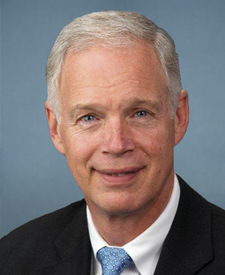
Ron Johnson (R-WI), a senator since 2011, has no public record of active individual-stock day-trading under the STOCK Act; his wealth is concentrated in privately held businesses (notably the plastics firm Pacur), real estate, and funds rather than tracked equities, so stock-trading concerns are minimal. The strongest accountability question is conflict-of-interest: he successfully fought to expand the 2017 tax law's pass-through deduction to 23% (settled at 20%), a benefit he publicly acknowledged applied to his own Pacur LLC, and ProPublica reported the carve-out disproportionately benefited two billionaire families who were among his largest donors. His reported net worth grew substantially over his tenure (roughly $24M to ~$65M median by some accounts), though much of that traces to the 2020 sale of Pacur, a pre-office asset, complicating any "enrichment beyond salary" inference. His voting attendance (about 2.8% missed, at the Senate median) and available records show no notable campaign-personal-use or family-lobbying findings, so those components score low or insufficient-data.
Public record
In Congress since
2011
Committees
Budget (Chairman) Finance Homeland Security and Governmental Affairs Senate Special Committee on Aging
Missed votes, 119th Congress
1.3% (12 of 915; median member 1.9%)
Campaign money, 2025–26 cycle
$1.1M raised · 3% from PACs & committees · $1.2M cash on hand FEC ↗
The stock-trading ban
Senate cloture on H.R. 7008, Sep 30, 2026
Yes
Cosponsored a ban bill
None
H.R. 7008 bans new stock purchases by members, spouses and dependents; it doesn't force sales of existing holdings. The Senate vote was on the version paired with the SAVE Act, which is why no Democrat voted yes. Full breakdown →
Disclosed stock trades
No periodic transaction reports on file since 2024. That's the norm: most members don't trade individual stocks, or hold them in blind trusts and diversified funds.
Amounts are the ranges members must report, not exact values. The STOCK Act requires a report within 45 days of a trade; "late" counts days past that deadline, measured to the filing date.
How the score breaks down
Stock self-tradingno data
25% weight
—
No public record of active individual-stock trading via STOCK Act periodic transaction reports. Congressional trade trackers (Quiver, MarketBeat) show no populated individual-equity trade history; his holdings are in private businesses, real estate, and funds rather than tracked single stocks. Per rubric, absence of trading scores 0, not penalized.
Reported net worth grew markedly over his tenure (one analysis cites median wealth rising from ~$24M in 2011 to ~$64.9M), and OpenSecrets/press put 2018 net worth near $39M. However, the largest single jump traces to the 2020 sale of Pacur (a pre-office asset, sold for $5M-$25M) and longstanding rental income, which the rubric excludes from scoring as pre-office wealth. Moderate score reflects ambiguity, not a clear salary-beating gain attributable to office.
Money → action alignmentcorrelation, not proof of any quid-pro-quo
20% weight
58
Correlation, not proof. Johnson cast a key vote for the 2017 tax law only after pushing to expand the pass-through deduction (sought 23%, landed at 20%); ProPublica reported the carve-out especially benefited the Uihlein and Hendricks families, among his largest donors, and he acknowledged his own Pacur LLC benefited. He has also taken ~$753K from oil & gas over his career while opposing climate legislation. The pass-through episode is a documented vote-aligned-with-donor-and-personal-benefit pattern; oil & gas is a smaller, more diffuse correlation.
No documented findings of campaign or leadership-PAC funds spent on personal benefit. A 2015 dispute concerned deferred compensation Johnson received from Pacur after self-funding ~$9M of his 2010 campaign, but election-law experts said a pre-campaign agreement made it lawful; this is a personal-compensation question, not campaign-fund personal use. No FEC enforcement action found.
No specific public record found of Johnson family members lobbying tied to his office, office-linked contracts, or a notable staff-to-lobbyist pipeline. Absence of data; scored 0 per rubric (not penalized).
Strong attendance: Johnson missed 151 of 5,432 roll-call votes (2.8%) from 2011 to mid-2026, equal to the Senate median. No record of heavy paid-speech income displacing official duties. Low score reflects a clean attendance record.
Sources behind this score: 2 data aggregator · 4 news reporting · 3 reference database. Score = weighted average of the components that have data; the 3 without sourced evidence are excluded, never counted against the member. Methodology →
Embed this score on your site
Updates automatically when the score changes.
Right of reply
Is something here wrong or missing context? Members and their staff can send a correction or a statement. Statements are published on this page in full, and corrections go in the public log. Email corrections@greederboard.com.