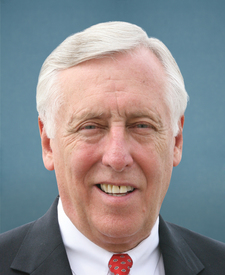
Steny Hoyer (D-MD5), in the House since 1981 and former Majority Leader/Whip, shows little evidence of personal self-dealing in the available public record. He is not a known active individual-stock trader; disclosures and trade trackers show mainly accounts and mutual funds rather than a high volume of single-stock transactions, and his estimated net worth (~$3.9M) is mid-pack for Congress and unremarkable given his 40+ year tenure. The clearest accountability flag is positional rather than financial: as a senior leader he publicly opposed a congressional stock-trading ban (2022) while maintaining a robust donor and leadership-PAC (AmeriPAC) fundraising operation tied to industries such as public-sector unions and electric utilities — a correlation, not proof of vote-buying. No FEC personal-use findings, family-lobbying scandals, or chronic absenteeism surfaced in public sources.
Public record
In Congress since
1981
Committees
Appropriations
Missed votes, 119th Congress
2.8% (19 of 674; median member 1.9%)
Campaign money, 2025–26 cycle
$402K raised · 64% from PACs & committees · $323K cash on hand FEC ↗
The stock-trading ban
H.R. 7008 passage, Jul 22, 2026
No
Cosponsored a ban bill
None
H.R. 7008 bans new stock purchases by members, spouses and dependents; it doesn't force sales of existing holdings. The Senate vote was on the version paired with the SAVE Act, which is why no Democrat voted yes. Full breakdown →
Disclosed stock trades
No periodic transaction reports on file since 2024. That's the norm: most members don't trade individual stocks, or hold them in blind trusts and diversified funds.
Amounts are the ranges members must report, not exact values. The STOCK Act requires a report within 45 days of a trade; "late" counts days past that deadline, measured to the filing date.
How the score breaks down
Stock self-tradingno data
25% weight
—
No record of active individual-stock trading. Quiver Quantitative's trade activity page for Hoyer is unpopulated (no listed trades/volume), and reporting on his disclosures describes holdings primarily as accounts and a mutual fund ($250k-$500k) rather than single-stock STOCK Act transactions. Per rubric, absence of trading = 0; not penalized.
Net worth estimated ~$3.9M in 2026, ranking ~189th in Congress — modest for a 45-year tenure and senior leadership role. Earlier OpenSecrets-era estimates ranged from low hundreds of thousands to low millions; ranges are wide and methodology-dependent. Growth appears broadly consistent with salary, pension, book royalties, and market gains; no documented enrichment beyond those sources, so a low score reflecting limited data rather than evidence of self-dealing.
Money → action alignmentcorrelation, not proof of any quid-pro-quo
20% weight
35
CORRELATION, NOT PROOF. As a longtime leader and prolific fundraiser, Hoyer's top industry donors have included public-sector unions (#1) and electric utilities (#2) in recent cycles, plus substantial lobbyist contributions. His AmeriPAC leadership PAC raises and redistributes millions ($4.1M raised/contributed in 2024 cycle). Donor concentration in regulated/labor sectors aligns directionally with his pro-labor and infrastructure voting, but no specific quid-pro-quo or donor-timed vote is documented. Moderate score reflects fundraising scale and donor concentration, not proven influence.
No FEC complaints, enforcement actions, or credible reporting found alleging personal use of campaign or AmeriPAC leadership-PAC funds. AmeriPAC spending in public records is directed to candidate contributions and independent expenditures (e.g., $500k for a 2026 MD-05 candidate), consistent with normal political activity. No data to support a positive score; not penalized for absence.
No evidence of family members lobbying on matters tied to Hoyer's office or of contracts steered to relatives. As a 45-year incumbent and former leader, his office is a known node in the staff-to-lobbyist pipeline (LegiStorm tracks numerous former staffers, some of whom enter lobbying), which is typical of senior offices but raises a modest structural flag. No specific scandal documented; low score reflects ordinary staff turnover rather than proven impropriety.
Hoyer's lifetime missed-votes rate is low relative to peers, with a notable cluster of missed votes in late 2018 attributed to illness/recovery. He is, however, a heavy fundraiser (millions raised/redistributed via AmeriPAC and for fellow Democrats), reflecting significant time on political money operations typical of leadership. Low-moderate score: strong attendance offsets heavy fundraising; no paid private speaking fees documented (barred for members).
Sources behind this score: 2 data aggregator · 1 news reporting · 7 reference database. Score = weighted average of the components that have data; the 2 without sourced evidence are excluded, never counted against the member. Methodology →
Embed this score on your site
Updates automatically when the score changes.
Right of reply
Is something here wrong or missing context? Members and their staff can send a correction or a statement. Statements are published on this page in full, and corrections go in the public log. Email corrections@greederboard.com.