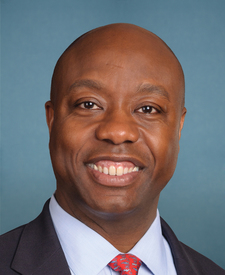
Senator Tim Scott (R-SC), now Chair of the Senate Banking Committee, presents a mixed accountability profile. His most documented issue is stock-trading transparency: roughly a dozen individual stocks (including Boeing, Apple, Palantir, defense and tech names) appeared on his 2022 financial disclosure without corresponding STOCK Act transaction reports, which watchdogs flagged as an apparent disclosure violation; his campaign asserted compliance but gave no specifics. His career fundraising is heavily concentrated in the finance/insurance/real estate sector (about $9.7M), which correlates with—but does not prove influence over—his pro-industry agenda chairing the Banking Committee (crypto/GENIUS Act, CFPB rollbacks). He missed roughly 110 Senate votes during his 2023 presidential run, a level typical of sitting senators seeking the presidency. No significant evidence surfaced of campaign-fund personal use, net-worth enrichment beyond normal ranges, or family/revolving-door self-dealing in public records reviewed.
Public record
In Congress since
2011
Committees
Banking, Housing, and Urban Affairs (Chairman) Finance Health, Education, Labor, and Pensions Small Business and Entrepreneurship
Missed votes, 119th Congress
3.0% (27 of 915; median member 1.9%)
Campaign money, 2025–26 cycle
$5.3M raised · 3% from PACs & committees · $4.9M cash on hand FEC ↗
The stock-trading ban
Senate cloture on H.R. 7008, Sep 30, 2026
Yes
Cosponsored a ban bill
None
H.R. 7008 bans new stock purchases by members, spouses and dependents; it doesn't force sales of existing holdings. The Senate vote was on the version paired with the SAVE Act, which is why no Democrat voted yes. Full breakdown →
Disclosed stock trades
No periodic transaction reports on file since 2024. That's the norm: most members don't trade individual stocks, or hold them in blind trusts and diversified funds.
Amounts are the ranges members must report, not exact values. The STOCK Act requires a report within 45 days of a trade; "late" counts days past that deadline, measured to the filing date.
How the score breaks down
Stock self-trading
25% weight
45
Roughly 11-12 individual stocks (Apple, Boeing, Palantir, Alphabet, Exxon, Citigroup, airlines, etc.) appeared on Scott's 2022 disclosure absent from 2021, with no STOCK Act transaction reports documenting the purchases. Boeing/Palantir holdings overlap with his Foreign Relations Committee role over arms sales; watchdogs called the non-disclosure an apparent STOCK Act violation. Holdings mostly $1,001-$15,000; Boeing $15,001-$50,000. No evidence of high-volume active trading or proven market-beating timing — issue is disclosure compliance and sector overlap rather than aggressive trading.
Disclosure-based net-worth estimates vary widely and are unreliable (ranges from roughly -$472K to ~$858K in one 2023 analysis; outside estimates differ by orders of magnitude). No credible evidence of net-worth growth beyond salary, book income, and market returns over his tenure. Pre-office business wealth (Allstate agencies, real estate) is not scored. No anomalous enrichment documented.
Money → action alignmentcorrelation, not proof of any quid-pro-quo
20% weight
40
CORRELATION, NOT PROOF. Scott's career receipts are heavily concentrated in finance/insurance/real estate (~$9.67M career: securities & investment ~$3.19M, real estate ~$2.38M, insurance ~$1.91M, commercial banks ~$729K). As Banking Committee Chair he advanced industry-aligned priorities — the GENIUS Act crypto/stablecoin framework and rollbacks of CFPB rules (e.g., overdraft-cap repeal). High donor concentration aligns with pro-industry agenda, but this reflects an ideologically consistent pro-finance record and committee jurisdiction; no quid-pro-quo evidence.
No documented personal-use violations. Reporting noted his 2024 presidential campaign spent heavily (~$32K on meals/travel over weeks, ~$18K/month on consultants) and routed some advertising/travel spending through two LLCs (Meeting Street Services; Advanced Planning and Logistics), reducing transparency — but heavy/opaque spending is not personal use. No FEC findings or watchdog allegations of converting funds to personal benefit surfaced.
No public-record evidence found of family members lobbying or holding office-tied contracts, nor of a documented staff-to-lobbyist pipeline specific to Scott. Standard databases (OpenSecrets, LegiStorm) track such data but searches surfaced no specific findings. Per rules, absence is not penalized.
Scott missed roughly 110 Senate votes between April and December 2023 while running for president (May-Nov 2023), and GovTrack ranked him among the most absent senators serving 10+ years in 2024. This level is typical for sitting senators seeking the presidency (Rubio, Obama, Clinton missed far higher shares), and his attendance outside that campaign window has been unremarkable. Heavy concurrent fundraising occurred ($6M in Q2 2023). Score reflects the temporary campaign-period absences.
Sources behind this score: 4 news reporting · 2 data aggregator · 3 reference database. Score = weighted average of the components that have data; the 2 without sourced evidence are excluded, never counted against the member. Methodology →
Embed this score on your site
Updates automatically when the score changes.
Right of reply
Is something here wrong or missing context? Members and their staff can send a correction or a statement. Statements are published on this page in full, and corrections go in the public log. Email corrections@greederboard.com.